


PrepareSheet 2 of 10Reviewed 28 September 2026
Wearing Ihram is not the same as entering Ihram.
The two steps, the five Miqat points, why the airplane matters, and what changes once you are in the state.
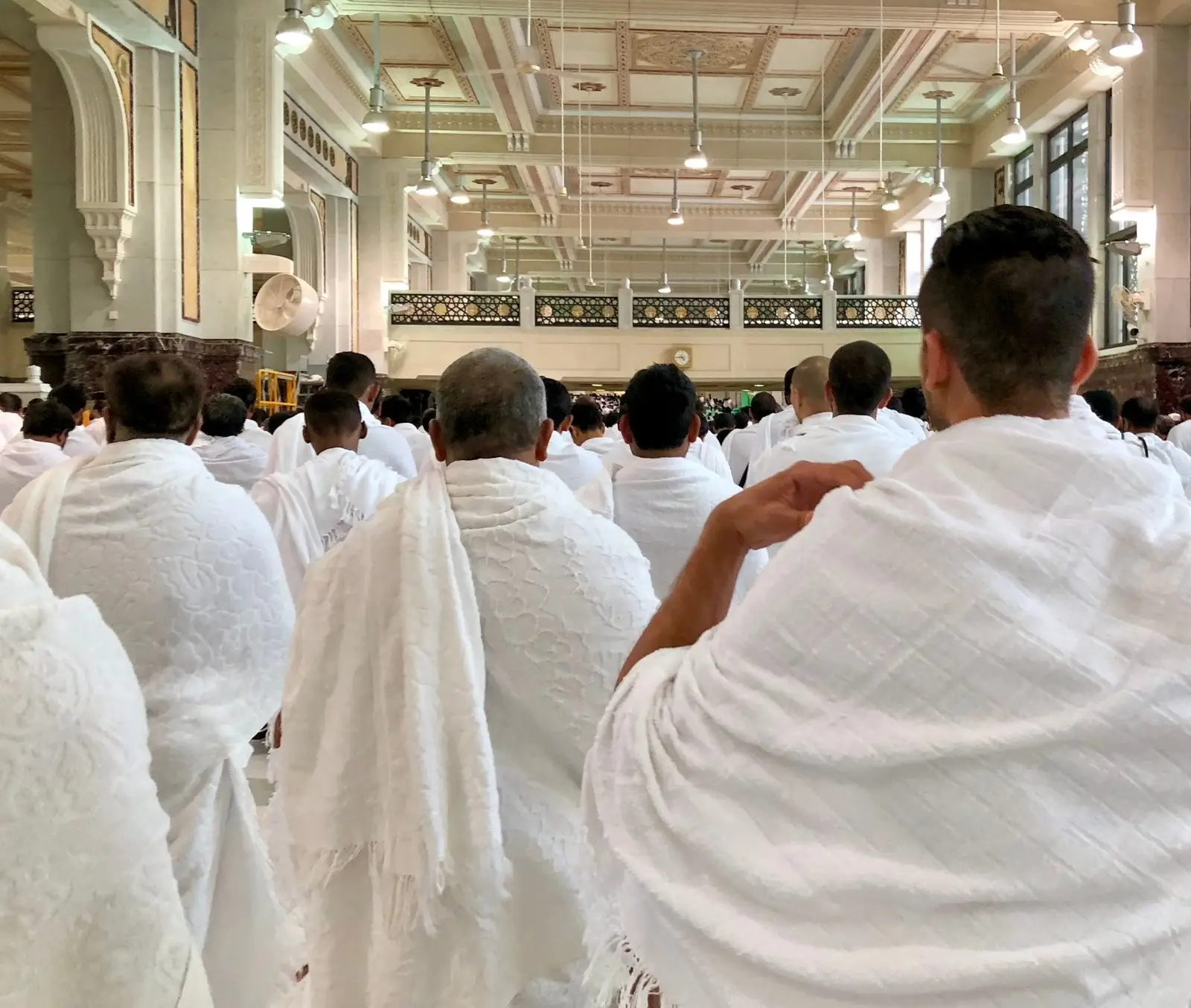
For men, putting on the two white garments does not by itself mean you have entered the state of Ihram. You can change hours earlier: at home, at your departure airport, or during a layover. Doha, Dubai, Abu Dhabi and Istanbul all have prayer rooms and space enough to do it without rushing.
You enter the state by making your intention and beginning the Talbiyah before you cross the Miqat.
Those are two separate acts, and confusing them is the single most common mistake first-time pilgrims make. The garments are preparation. The intention and the Talbiyah are what actually put you into Ihram.
The five Miqat points
Five stations mark the boundary, one for each direction pilgrims arrive from. Which one applies to you is decided by your route, not by your nationality.
Which Miqat is mine?
Your route decides it, not your passport. Pick how you arrive.
Schematic. Directions are true; distances are labeled rather than drawn, because Dhul Hulayfah is five times further out than Qarn al-Manazil and a true scale would put the other four on top of Makkah.
All five, in full
Dhul Hulayfah
North · ~280 miles
Anyone traveling from Madinah
Al-Juhfah / Rabigh
North-west · ~118 miles
The Levant, Egypt, North Africa, Europe — and most North American flight paths
Dhat Irq
North-east · ~56 miles
Iraq, Iran and north-eastern approaches
Qarn al-Manazil
East · ~50 miles
Najd, the Gulf, Pakistan, Malaysia, Australia — and Taif arrivals
Yalamlam
South · ~62 miles
Yemen and southern approaches
This answers a routing question, not a ruling. If you cross without Ihram, or break a restriction, there are established answers — ask your group's scholar with the specifics rather than acting on a page.
Why the airplane matters
Jeddah lies inside the Miqat boundary. If you fly Makkah-first through Jeddah, your aircraft normally crosses the Miqat before it lands, which means the in-flight announcement that you are approaching the Miqat is not your signal to start getting ready. By then it is already late. Prepare in the air, and change at your layover if you have one.
Arriving Madinah-first changes the whole picture: you enter Ihram later, at Dhul Hulayfah, usually with your group and with time to do it calmly. If you have a choice of routing and this matters to you, it is worth weighing before you book.
What changes in Ihram
Restricted for everyone, once the state is entered:
- Perfume and scented products — go fully unscented, including soap and sunscreen
- Cutting hair or nails
- Hunting land animals
- Marriage contracts and proposals
- Marital intimacy, and what leads to it
- Arguing, foul language and quarrelling
For men
No fitted or stitched garments, and no covering the head directly. An umbrella is fine, and on the Mashair days a light-colored one is close to essential.
For women
Per most scholars, no niqab and no gloves. Ordinary modest Islamic dress otherwise — there is no uniform and no required color. Further guidance is on the For Sisters page.
If something goes wrong
Crossed the Miqat without Ihram? Broke a restriction without meaning to? There are established answers for nearly every scenario. Many carry no penalty at all, and others have simple remedies.
Ask your group’s scholar with the specifics: what you did or missed, when, your Hajj type, and whether you were in Ihram at the time. Those four details are usually enough to get a clear answer in a minute. What will not help is a forwarded voice note, a group-chat discussion, or five different opinions from people who were not there.