


LearnSheet 1 of 6In draft
Hajj is unlike any other journey you will ever take.
The fifth pillar, the five days, whether it is obligatory on you yet, and how the modern system works.
Before Hajj becomes a Nusuk account, a package, a flight, or a hotel, it is an act of worship Allah has called us to.
For most people, the journey begins with questions. Is Hajj obligatory on me yet? What actually happens during those days? What do Mina, Arafah and Muzdalifah have to do with it? And where does Nusuk fit into all of this?
So we’ll start at the beginning: what Hajj is, when it becomes obligatory, what happens during the days of Hajj, and how the modern Hajj process works today.
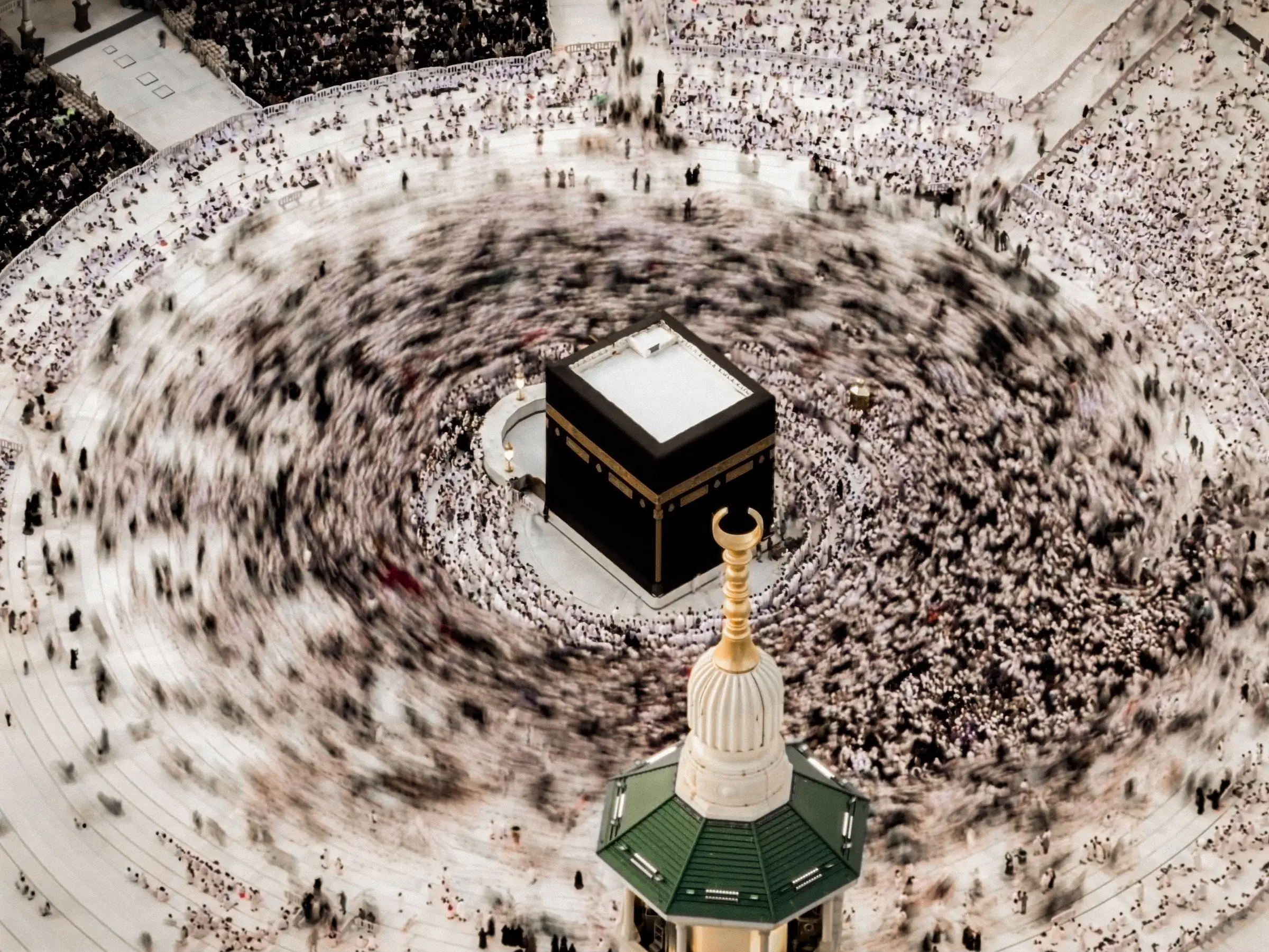
Hajj is worship. The flights, the portal and the camps are logistics wrapped around it.
The five days, on one map
Four places, eighteen kilometres end to end, drawn where they actually are. Mina is a valley with the Jamarat at its western end; Muzdalifah is open floor you cross on the way out and sleep on coming back; Arafah is a plain, not a suburb of Makkah. Once the ground has a shape, everything else on this site has somewhere to attach.
8 Dhul-Hijjah
Drawn to scale from the real coordinates. Distances are straight line; by road each leg is longer.
8 Dhul-Hijjah
Makkah to Mina
Yawm at-Tarwiyah. You enter Ihram for Hajj — intention and Talbiyah — and move to Mina with your group. Each prayer in its own time, shortened but not combined. Then rest, because tomorrow is the one that matters.
9 Dhul-Hijjah · morning
Mina to Arafah
Past Muzdalifah, to the plain. Confirm you are inside the boundary. Dhuhr and Asr per your group’s guidance, and then du’a until sunset — this is the standing, and Hajj is Arafah. Do not leave before sunset.
9 Dhul-Hijjah · night
Arafah to Muzdalifah
After sunset you move back, and spend the night under open sky with almost no facilities. Collect small pebbles for the Jamarat. The simplicity is the lesson rather than a failure of the arrangements.
10 Dhul-Hijjah
Muzdalifah to Mina, and to Makkah
Yawm an-Nahr, the busiest day of Hajj. Rami of Jamrat al-Aqabah, the sacrifice, then cutting or shaving the hair and the first exit from Ihram. Tawaf al-Ifadah in Makkah, then back to Mina.
11–13 Dhul-Hijjah
The days of Tashriq, in Mina
Rami of all three Jamarat each day, in order, at your group’s time. Dhikr, du’a, worship. These days are Hajj — not the part that comes after it.
Before departure
Mina to Makkah
Tawaf al-Wada’, the farewell, for those required to perform it. Your last act before leaving Makkah. Do not rush it to catch a bus that was going to wait anyway.
Is Hajj obligatory on me?
8–13
Dhul-Hijjah
The days of Hajj, on the Islamic calendar
Hajj becomes obligatory when you are Muslim, adult, of sound mind, and able — physically able to make the journey, and financially able to cover it and your dependants’ needs without unmanageable debt.
What “able” means in your circumstances (a health condition, a debt, a family obligation) is a question for a qualified scholar rather than for a website. If you are unsure, ask. That conversation is itself part of preparing.
When is Hajj?
The days of Hajj are fixed on the Islamic calendar: 8–13 Dhul-Hijjah. Because the Islamic calendar is about eleven days shorter than the Gregorian calendar, Hajj moves earlier each year.
For Hajj 2027, the days of Hajj are expected to fall in mid-May, insha’Allah. The exact dates will ultimately depend on the sighting of the moon.
But here is the part that matters when you are planning your life around Hajj: you are not only travelling for those five or six days.
Most Hajj packages designed for pilgrims coming from the West are likely to fall somewhere around these travel windows:
- May 6 – May 20/21
- May 10 – May 20/21
- May 10 – May 26
The exact dates will depend on the package, whether Madinah is included before or after Hajj, the airline schedule, and how long the programme is designed to be.
So if you are planning time off from work, childcare, school schedules, or anything else at home, plan for the larger Hajj travel window, not simply the days of Hajj themselves.
And one important reminder: dates published this far in advance are planning dates. The beginning of Dhul-Hijjah, and therefore the exact days of Hajj, are confirmed closer to the season.
Roughly what does it cost?
The package price, plus flights where they are not included, plus vaccinations, gear, insurance and incidentals. Recent complete costs for US pilgrims have commonly landed in the five figures, varying widely by tier and season.
Treat any specific number you hear as last year’s number until the new packages are published. The Real Cost of Hajj breaks down everything the package does not cover, which is where most people are surprised.
How the modern system works
For pilgrims in countries within the Direct Hajj Program, including the US and Canada, Hajj runs through Nusuk Hajj, the Saudi Ministry’s official platform. Packages are delivered by authorized service providers, and operators guide you through the platform and serve your group on the ground.
The path looks like this:
Thinking about Hajj → Registration → Verification → Package selection → Booking → Preparation → Travel → Hajj
How ready are you?
Eleven practical questions. Not about whether Hajj is obligatory on you — that is a question for a scholar, not a website — but about what is actually in place, and what to do about what is not.
Do you know which booking system applies to you?
Nusuk, or your own country’s Hajj mission. Residence decides it, not your passport.
Is your Nusuk account created and verified?
Verified, not just created. They are different states.
Are your passport and photo ready at the portal’s sizes?
Oversized photos are one of the most common causes of verification delay.
Do you know the real total, not just the package price?
Flights, the gateway, vaccinations, gear, insurance, the hady, gifts.
Could you pay within the window if it opened next week?
Funded, and your bank’s limits checked — not at 2 a.m. on launch day.
Could you perform the rites without reading from a screen?
Each rite: what, when, why, and the mistake people make.
Do you know your Miqat and the rules of Ihram?
Your route decides the Miqat, and wearing Ihram is not the same as entering it.
Could you walk for several hours, in heat, on consecutive days?
Fifteen to twenty-five kilometres a day is normal during the Mashair days.
Have you spoken to a doctor about the journey?
Vaccinations, chronic conditions, and medication documentation.
Are your debts and people’s rights settled?
The one people leave too late — and the one felt at Arafah and nowhere else.
Will you hear it when something changes?
Registration windows open with little warning and close quickly.
Answer the questions and your next steps appear here.
Both sides of the journey
There are flights and hotels, apps and documents, packages and camps and buses, and a vocabulary nobody has taught you yet. That is the part that gets you there.
The rest is worship. Five days in which millions of Muslims arrive from every corner of the world answering the same call, and you are one of them.
We cover both. Most of these pages are paperwork, because that is where people get stuck.